というThe Journal of Economic Education掲載論文をタイラー・コーエンが紹介している。原題は「Economic literacy and public policy views」で、著者は Jared Barton(カリフォルニア州立大学チャンネルアイランド校)、Cortney Rodet(オハイオ大学)。
以下は3年前のWP(SSRN版)からの引用。
We find that men, older Americans, Americans without children, Republicans, and the more educated have higher economic literacy. Family income is unrelated to economic literacy, though Black and Hispanic Americans have lower economic literacy (including conditional on education and income). Somewhat surprisingly, economic literacy had little to do with respondents’ views: of the 26 questions on the roles and responsibilities of government and on current public policy debates, the coefficient on only four of these questions was statistically significant after controlling for covariates and correcting for multiple comparisons. Specifically, economic literacy is negatively correlated with support for more military spending and for more spending on the arts, and also negatively correlated with the belief that it is the government’s responsibility to control prices and to reduce income inequality. While one could characterize these relationships as suggesting economic literacy is correlated with holding more laissez faire political positions, for most questions the relationship was small and insignificant (and on many, the point estimate was not in line with what we would characterize as laissez faire views).
As few of the respondents’ policy views were correlated with economic literacy, there were generally few differences between “raw” policy preferences and our estimates of “fully economically literate” ones. If we examine “net favorability” (the percentage of respondents supporting/in favor of a policy less the percentage of those not in favor/opposing it), the average absolute change in net favorability (i.e., support for the policy less opposition to that policy) was 7.9 percentage points. In only one case did net favorability change sign: raw preferences for military spending exhibited 12.5 percent net support, while “fully literate” preferences exhibited -8.7 percent net support (that is, 8.7 percent more opposition than support).
These average changes, however, obscure significant political heterogeneity in the relationship between economic literacy and policy views. When we divide our sample by political party, we find that fully economically literate views of Democrats and Republicans are more divided than are their unadjusted policy views. The average divide between partisans in net favorability across our 26 questions is 45 percentage points in the raw data but grows to 85 percentage points in the estimated fully literate policy preferences. Fully economically literate preferences of both parties are (a) strongly in support or opposition to each policy, spending item, or potential responsibility of government, and (b) decisively at odds with one another on nearly every question. Indeed, on eight questions, Democrats and Republicans went from being on the same side of an issue (i.e., having the same sign net favorability) to being on opposite sides (opposite-signed net favorabilities).
(拙訳)
男性、高齢の米国人、子供のいない米国人、共和党員、高学歴の人の経済知識が高いことを我々は見い出した。家計収入は経済知識と関係していなかったが、黒人とヒスパニックの米国人の経済知識は低かった(教育と所得の条件付きの場合を含む)。やや驚くべきことに、経済知識は回答者の見解とあまり関係が無かった。政府の役割と責任、および、現行の公共政策の議論に関する26の質問において、共変量をコントロールし、多重比較を修正した後に係数が統計的に有意だったのは、それらの質問のうち4つだけだった。具体的には、経済知識は、軍事支出拡大への支持ならびに芸術に対する支出拡大への支持と逆相関しており、物価コントロールと所得格差縮小が政府の責任であるという考えとも逆相関していた。この関係を、経済知識はより自由放任主義的な政治的立場と相関していることを示す、と特徴付けることもできるが、大半の質問において関係は小さく非有意であった(そして多くにおいて、点推定は自由放任主義的な見解と特徴付けられるものと整合的ではなかった)。
回答者の政治的見解は経済知識とあまり相関していなかったため、全般的に「元の」政治的嗜好と、我々が推計した「完全な経済通の」政治嗜好*1との間にはあまり違いが無かった。「純支持」(政策を支持ないし好む回答者の割合から、政策を好まないないし反対の割合を差し引いたもの)を調べてみると、純支持(即ち、政策支持と政策反対の差)の変化の絶対値の平均は7.9%ポイントだった。純支持の符号が変わったのは一例だけで、原データでは軍事支出への純支持は12.5%ポイントだったが、「完全な経済通の」嗜好では純支持は-8.7%だった(即ち、反対が支持より8.7%多かった)。
だが、この平均的な変化は、経済知識と政治的見解の関係における顕著な政治的な異質性を曖昧にしてしまう。我々のサンプルを政党で分けると、民主党と共和党の完全な経済通の見解は、調整されていない政治的見解よりも乖離していることを我々は見い出した。26の質問での純支持において、党派による平均的な乖離は、原データでは45%ポイントだったが、推計された完全な経済通の政治的嗜好では85%ポイントに拡大する。両党派の完全な経済通の嗜好は、(a)各政策、支出項目、政府の潜在的な責任について強く支持もしくは反対し、(b) ほぼすべての質問についてまったく相容れない。実際、8つの質問については、民主党員と共和党員は、その問題に対して同じ側に立つ(即ち、純支持の符号が同じ)から、反対側に立つ(純支持の符号が逆)に移行した。
以下は完全な経済通を想定する前(〇)と後(*)の乖離を示した図(濃い灰色が民主党員、薄い灰色が共和党員)。
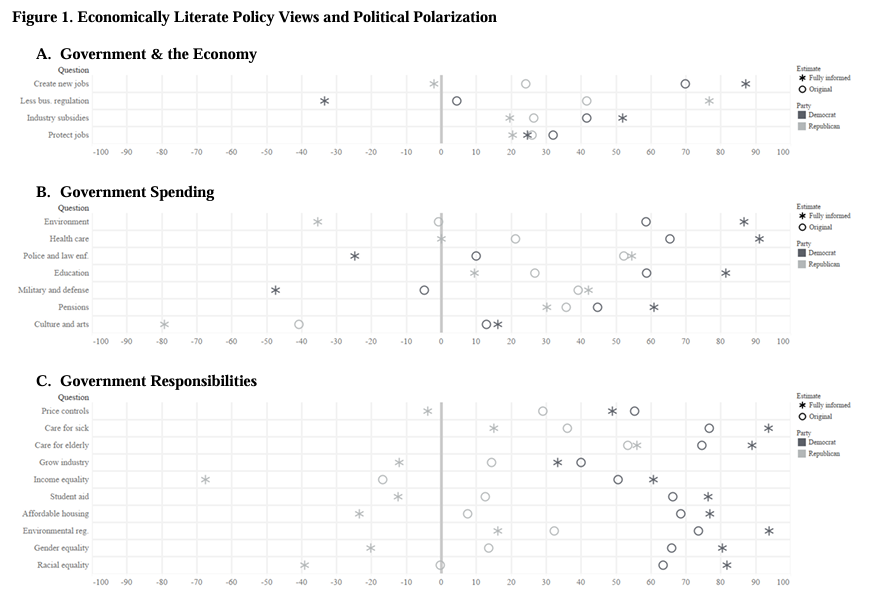
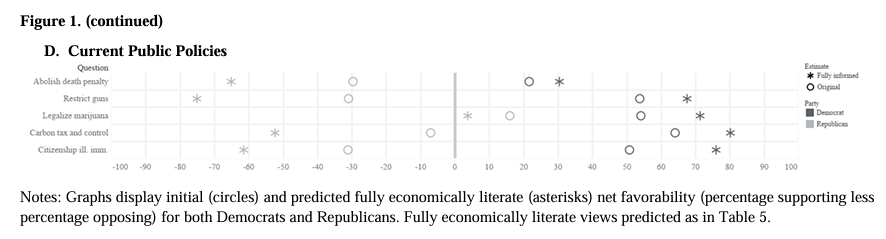
*1:本文では推計方法を「For each policy question, we estimate an ordered probit of that question on respondents’ economic literacy, their demographic and socioeconomic characteristics, and the interaction of economic literacy and these characteristics. We then replace the respondent’s actual literacy score with a perfect score, interact this again with their characteristics, and predict each respondent’s probability distribution over the possible answers.」と説明している。
