というEdward Glaeserらの論文をタイラー・コーエンが「This is one of the best and most important economics papers I have seen in the last few years」として紹介している。原題は「Economic integration and upward mobility in Brazil」で、著者はRadu Barza(独立研究者)、Edward Glaeser(ハーバード大)、César A. Hidalgo*1(トゥールーズ大)、Martina Viarengo*2(国際・開発研究大学院)。
以下は、コーエンが「a useful thread on the paper」と評した著者の一人(Hidalgo)による解説スレッド。
In the cities of northern Brazil, more than 50% of the workers who start poor* are still poor 7 years later. But in southern Brazil, only a third are. Why? 👇🧵
*<1.5x minimum wage
Our new paper with Radu Barza, Ed Glaeser & Martina Viarengo uses 900M+ employer–employee records to explore this question.
Bigger cities pay an urban wage premium.
But city size is a black box that we must illuminate.
To explain agglomeration premia, we first estimate the extra wage associated with a city after accounting for a worker's age, education, industry, etc.
Then, we explore how this premium relates to size, economic structure, and social mixing.
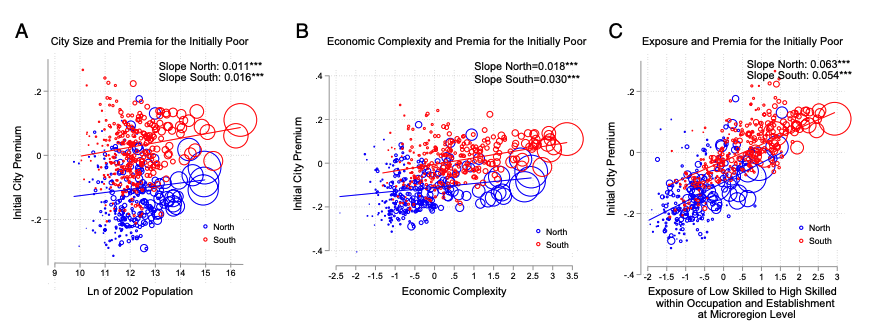
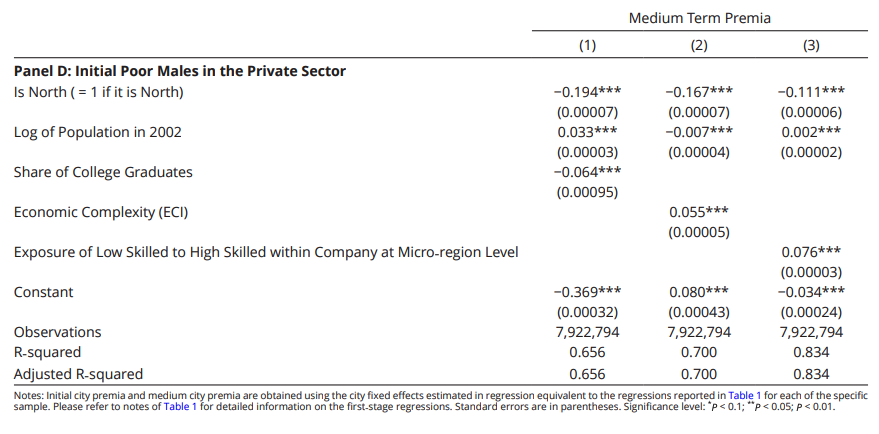
As expected, larger cities pay better, especially in the south. But the effect of size becomes tiny or even changes sign once we add economic complexity (ECI) or social mixing to the model.
The first (ECI) is a measure of the capabilities present in an economy obtained from industries by city data. The second one (Social Mixing) is a measure of how often low- and higher-income workers share a workplace.
The point is that the structure of a city, and its ability to mix people, explain wage premiums much better than its size.
In fact, workplace mixing is particularly strong. For initially poor workers, models with workplace mixing explain about 77% of the variation in initial city wage premiums and 83% of the variation in medium-term premiums.
This explains much of the north–south divide. Cities in the south of Brazil specialize in more complex industries that mix the skilled and the less skilled at the workplace.
Northern cities cluster skilled workers in the public sector, generating much less integration.
We do not claim these results to be causal. But the findings are consistent with a hypothesis that sheds light on the black box of agglomeration: the idea that agglomeration operates through workplace mixing as a mechanism that enables learning and promotes better wages.
Future work will need to test this causally and explore alternatives. But the broader lesson is about illuminating this "black box." The idea is that what matters is not how many people a city brings together, but how people combine.
Get the full paper at:
https://pnas.org/doi/10.1073/pnas.2604542123
https://centerforcollectivelearning.org/papers#papers
(拙訳)
ブラジル北部の都市では、貧困(最低賃金の1.5倍以下)から出発した労働者の半分以上が、7年後も依然として貧しいままである。しかしブラジル南部では、3分の1だけである。なぜだろうか?
Radu Barza、Ed Glaeser、Martina Viarengo との我々の新しい論文は、900万以上の雇用者と被雇用者の記録を用いてこの問題を追究した。
より大きな都市は都市賃金プレミアムを支払う。
しかし都市の規模は我々が解明すべきブラックボックスである。
集積プレミアムを説明するため、我々はまず、労働者の年齢、教育、産業、等を考慮した上で、都市に関連する追加的な賃金を推計した。
次いで我々は、このプレミアムがどのように規模、経済構造、および社会的混在と関連しているかを追究した。
予想した通り、大都市ほど賃金が高く、特に南部においてそうである。しかし、モデルに経済複雑性(ECI*3)もしくは社会的混在を追加すると、規模の効果は小さくなるか、符号を転じさえする。
前者(ECI)は、都市データの各産業から得られた経済に存在する能力の指標である*4。後者(社会的混在)は、低所得と高所得の労働者がどの程度同じ職場にいるかの指標である。
要点は、都市の構造ならびに人々を混在させる能力が、規模よりも賃金プレミアムを良く説明できる、ということである。
実際、職場での混在は特に強力である。当初貧しかった労働者について、職場での混在を備えたモデルは、当初の都市賃金プレミアムのバラつきの約77%、中期のプレミアムの83%を説明する。
これは南北の分断をかなり説明する。ブラジル南部の都市はより複雑な産業に特化しており、そうした産業では技能労働者と技能の低い労働者を職場で混在させる。
北部の都市は公的部門で技能労働者を集めるため、統合度合いが低い。
この結果が因果関係を示すものだと主張するつもりはない。だがこの発見は、集積のブラックボックスに解明の光を当てる仮説と整合的である。即ち、集積が、職場での混在を通じて、学習を可能にし、賃金上昇を促すメカニズムとして働く、というアイディアである。
今後の研究では、この因果性を検証するとともに、代替仮説を追究する必要があるだろう。しかしより広範な教訓は、この「ブラックボックス」の解明についてである。重要なのは都市が何人集めるかではなく、人々がどのように結び付くかにある、というアイディアである。
論文全体は以下で取得されたし:
https://pnas.org/doi/10.1073/pnas.2604542123
https://centerforcollectivelearning.org/papers#papers
*2:Martina Viarengo - Wikipedia。
*4:本文では「Formally, we estimate the ECI as defined by Hidalgo and Hausmann (16) and Hidalgo (44), starting from a matrix that counts the number of firms operating in an industry in each region (SI Appendix, Appendix D). The ECI is a widely used development indicator (44) designed to estimate the presence of multiple complementary factors or capabilities (45). The learning model of Glaeser (43) also implies the human capital externalities documented by Rauch (46), Moretti (47), and Chauvin et al. (48). Consequently, we also control for the share of adults with a college degree in the region.」と説明している。
