というNBER論文が上がっている(ungated版にリンクしたForecasting Research Instituteのページ)。原題は「Forecasting the Economic Effects of AI」で、著者はEzra Karger(シカゴ連銀)、Otto Kuusela(Forecasting Research Institute)、Jason Abaluck(イェール大)、Kevin Bryan(トロント大)、Basil Halperin(バージニア大)、Todd Jones(ミシシッピ州立大)、Connacher Murphy(スタンフォード大)、Phil Trammell(同)、Matt Reynolds(Forecasting Research Institute)、Dan Mayland(同)、Ria Viswanathan(同)、Ananaya Mittal(同)、Rebecca Ceppas de Castro(同)、Josh Rosenberg(同)、Philip E. Tetlock(ペンシルベニア大)。
以下はその要旨。
We elicit forecasts of how AI will affect the U.S. economy, comparing the beliefs of five groups: academic economists, employees at AI companies, policy researchers focused on AI, highly accurate forecasters, and the general public. The median respondent in each group expects substantial advances in AI capabilities by 2030, small declines in labor force participation consistent with demographic shifts, and an annual GDP growth rate of 2.5%, which exceeds both the typical medium-run (2.0%) and long-run (1.7%) baseline forecasts from government agencies and private-sector forecasters. Conditional on a “rapid” AI progress scenario, in which AI systems surpass human performance on many cognitive and physical tasks, experts forecast substantial, though not historically unprecedented, economic shifts: annualized GDP growth rising to around 4% and the labor force participation rate falling from its current level of 62% to 55% by 2050, with roughly half of that decline—equivalent to around 10 million lost jobs—attributable to AI. A variance decomposition suggests that expert disagreement about these effects is driven primarily by different beliefs about the economic effects of highly capable AI systems rather than by disagreement about the pace of AI progress. These forecasts map onto notably different policy preferences across groups: experts strongly favor targeted measures such as worker retraining, whereas the general public supports both targeted programs and broader interventions, including a job guarantee and universal basic income.
(拙訳)
我々は、AIがどのように米国経済に影響するかの予測を聴取し、5つのグループの考えを比較した。学界の経済学者、AI企業の従業員、AIに重点を置いた政策研究者、予測精度の高い予測者、および一般市民である。各グループの平均的な回答者は、2030年までにAIが顕著に進歩すること、人口動態の変化と整合的な労働参加率の小幅な低下、政府機関と民間部門の予測者の標準的な中期(2.0%)と長期(1.7%)のベースライン予測を共に上回る2.5%の年間GDP成長率を予測した。多くの認知的ならびに物理的な業務でAIシステムが人間のパフォーマンスを超える「急速な」AI進歩シナリオでは、専門家は顕著だが前例が無いわけではない経済的変化を予測する。即ち、年間GDP成長率は4%前後に高まり、労働参加率は現行の62%から2050年には55%に低下する。労働参加率低下のおよそ半分――約1000万の職の喪失に相当――はAIが原因である。分散分解が示すところによれば、こうした影響に関する専門家の意見の不一致は主に、AI進歩のペースについての意見の違いではなく、能力の高いAIシステムの経済的影響について考えが違うことから生じている。以上の予測は、グループ間でかなり異なる政策嗜好に帰結する。専門家は、労働者の再訓練のような対象を定めた手段を強く選好する半面、一般市民は対象を定めた政策と、ジョブギャランティとユニバーサル・ベーシックインカムなどの広範な政策措置の両方を支持する。
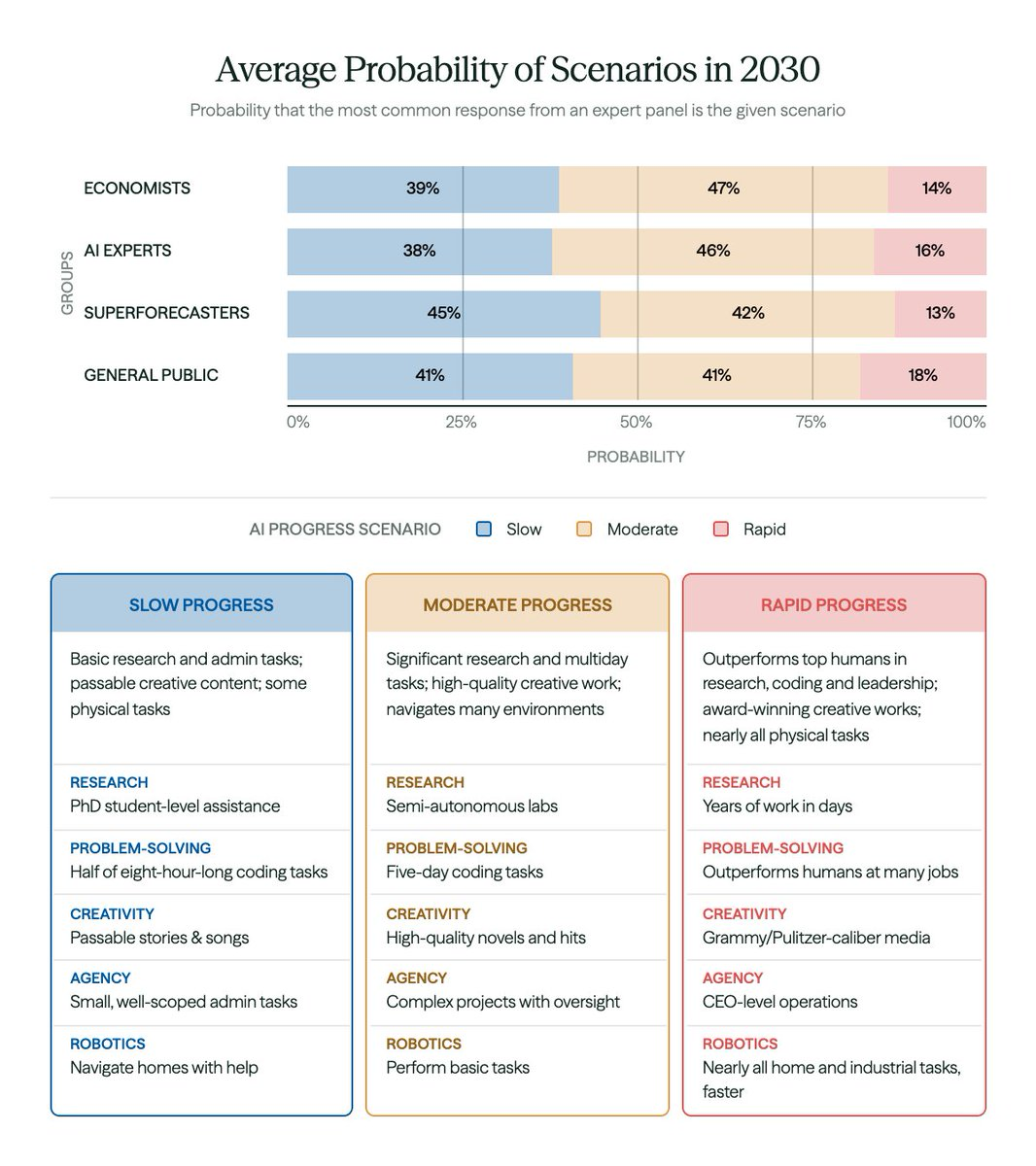
こちらのツイートでは論文の内容を解説している。それによると、経済学者は、2030年までのAIの急速な進歩シナリオに14%、中程度の進歩シナリオに47%、遅い進歩シナリオに39%の確率を割り当てたという。中程度か急速なシナリオの61%は概ね他のグループと整合的とのことである。
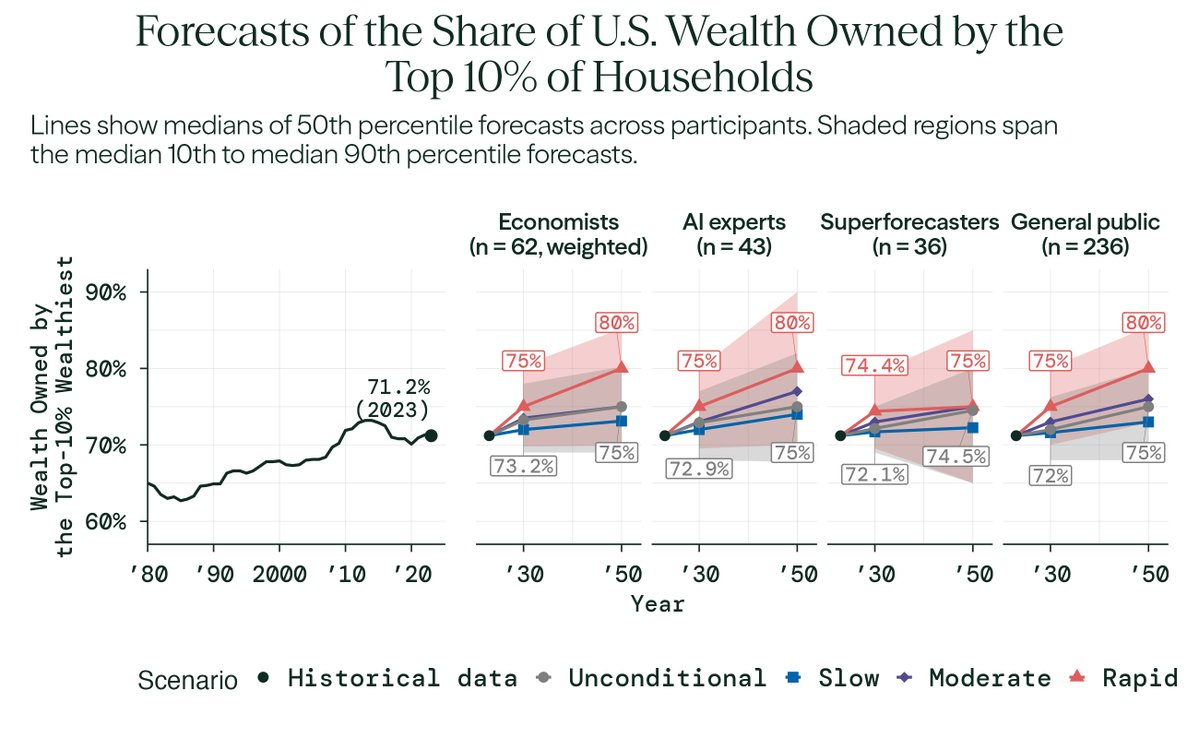
急速シナリオで経済学者は、上位10%の家計が2030年には米国の富の75%、2050年には80%を握ると予測したとの由。
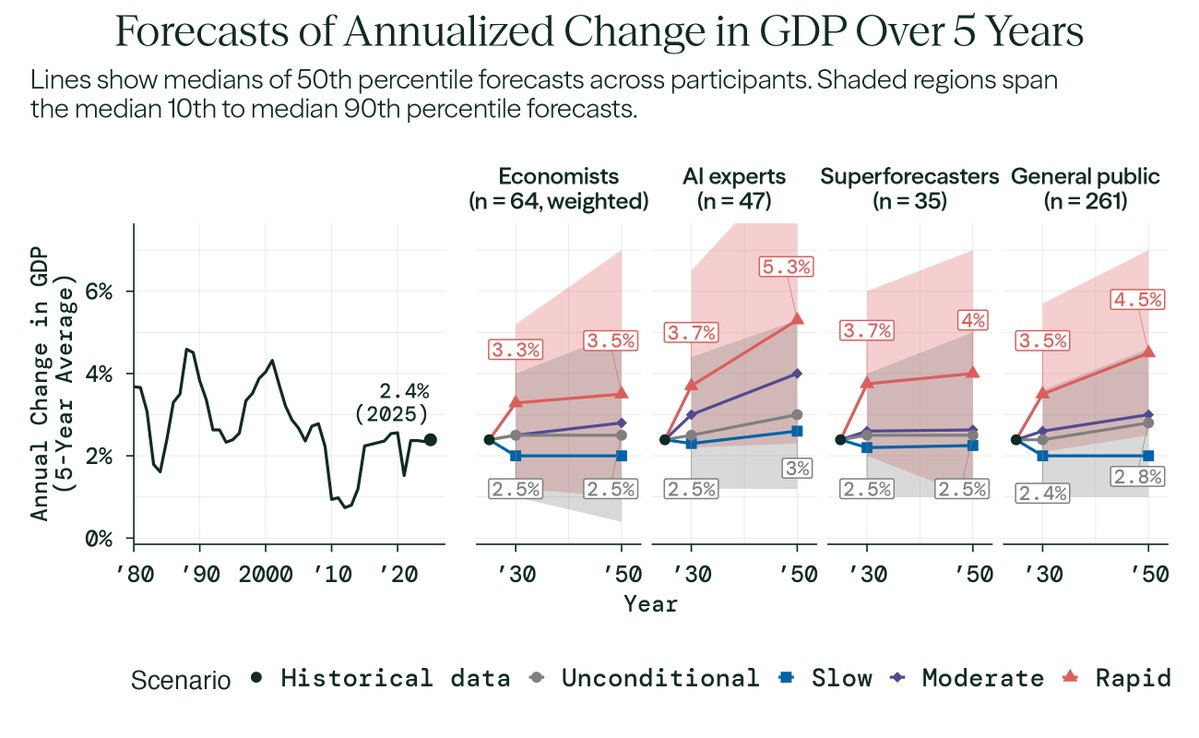
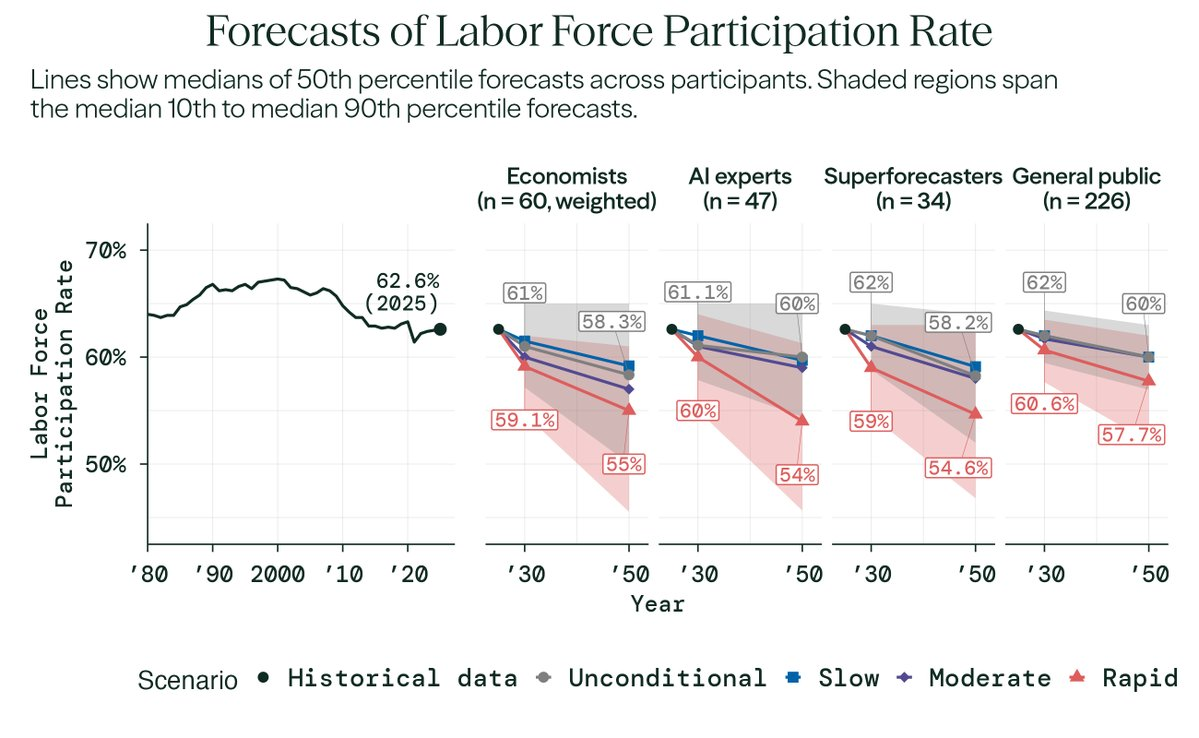
また、経済学者は、AIが進歩する確率が高いと見ているにもかかわらず、経済的な結果が劇的には変わらないと全般的には考えている理由として以下を挙げたという。
- 各部門でのAIの波及が遅く不均一であること
- インフラのボトルネック(エネルギー、半導体、データセンター)
- 人口動態と地政学の逆風
- 汎用技術の発見と測定される生産性の利得の間の長いラグ
